
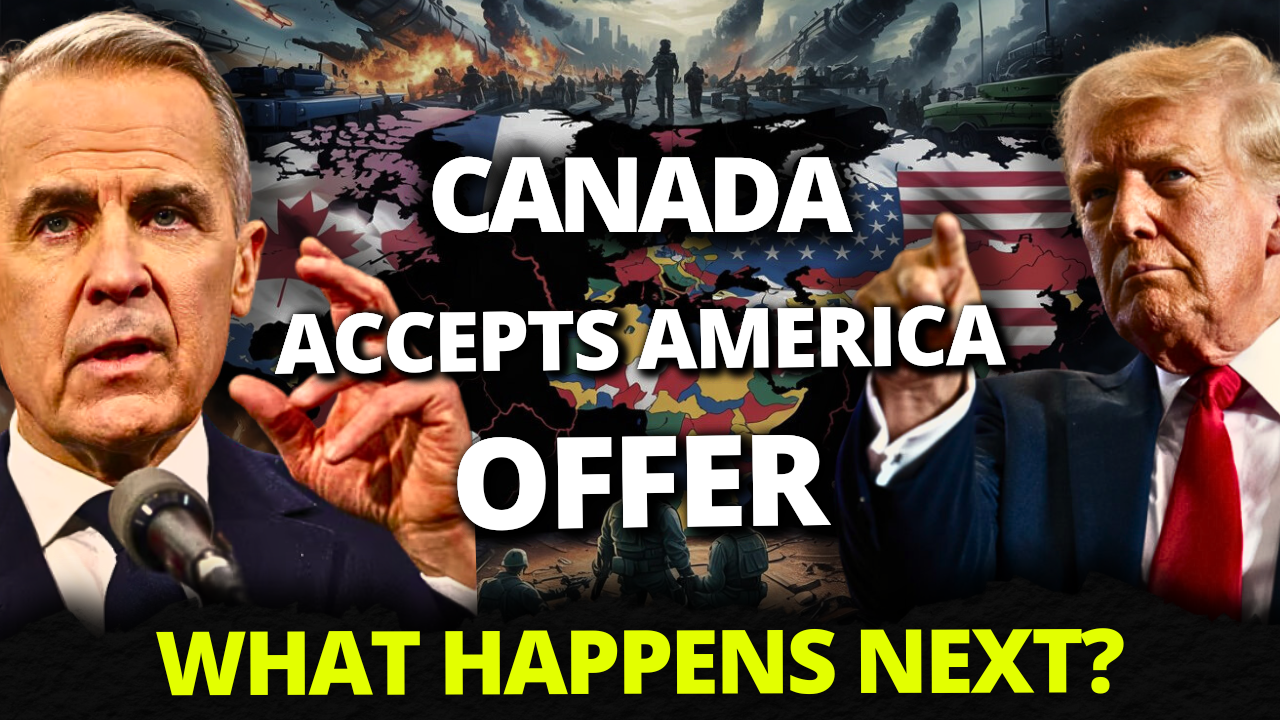
A new offer.
Unexpected.
Unprecedented.
And now… accepted.
But what does it mean when the world’s longest
undefended border becomes
the front line of a new economic confrontation?
What happens when a sovereign nation agrees to renegotiate its future under pressure from a superpower threatening annexation?
This is not just diplomacy.
This is brinkmanship.
And the next move…
could change everything.
Before we unravel the geopolitical implications of this seismic shift, I urge you—subscribe to this channel, like this video, and share your thoughts in the comments. Your engagement fuels our mission to deliver in-depth, thought-provoking analyses on the world’s most pressing issues. Stay informed. Stay vigilant.
In a move that has sent shockwaves through the international community, Canada has agreed to enter early renegotiations of the United States-Mexico-Canada Agreement (USMCA) at the behest of U.S. President Donald Trump. This decision comes amidst escalating tensions, with the U.S. imposing a 25% tariff on all Canadian imports, including a 10% tariff specifically targeting Canadian energy products.
Canada’s response was swift and resolute. The government announced retaliatory tariffs on $30 billion worth of U.S. goods, encompassing a wide range of products from agricultural goods to consumer electronics.
The economic interdependence between these two nations cannot be overstated. In 2023, Canada exported approximately C$550 billion worth of goods and services to the U.S., accounting for over three-quarters of its total exports. Energy alone constituted 30% of these exports.
The stakes are high. The livelihoods of millions hang in the balance as these two allies navigate a treacherous path toward redefining their economic relationship.
The Offer and Its Implications
President Trump’s unexpected proposal in early 2025 to renegotiate the United States-Mexico-Canada Agreement (USMCA) ahead of schedule sent shockwaves through North America. But it wasn’t just about tweaking tariffs or updating clauses—it was a bold strategic maneuver. Trump, known for his hardline and unconventional diplomacy, leveraged both economic pressure and political theater. By reintroducing tariffs on Canadian steel and aluminum and publicly suggesting that Canada could “benefit” from becoming the 51st U.S. state, he escalated the stakes beyond trade, testing the very resilience of Canadian sovereignty.
The message was clear: the U.S. wanted more control over supply chains, greater access to Canadian energy markets, and stricter provisions on digital commerce and data localization. Trump framed it as modernization—critics called it economic strong-arming.
Caught in the crosshairs was newly elected Prime Minister Mark Carney. A former central banker with international credibility, Carney was no stranger to high-stakes negotiations. He recognized that refusing outright could invite deeper economic retaliation, potentially rattling markets and disrupting trade flows vital to Canada’s economy. Instead, he opted to enter the negotiations with guarded openness, signaling Canada’s willingness to engage—but on its own terms.
Carney’s administration emphasized three pillars: protecting national sovereignty, maintaining equitable access to U.S. markets, and reinforcing environmental and labor standards already embedded in USMCA. In press conferences, Carney reiterated that any new deal must benefit all parties and reflect the values of modern democracies—not just the political goals of one administration.
However, the political fallout inside Canada was swift and severe. Opposition parties accused Carney of capitulating to U.S. bullying. Media outlets debated whether Trump’s aggressive approach constituted economic coercion or simply hardball deal-making. Former diplomats warned that entertaining renegotiation under such pressure set a dangerous precedent—one that could embolden future American administrations to erode Canadian autonomy in exchange for economic stability.
On the streets, the Canadian public was split. Some feared job losses and economic downturns if relations with the U.S. soured. Others rallied behind national pride, urging the government to stand firm against perceived American overreach.
As negotiations loom, the stakes are no longer just economic. They touch on identity, sovereignty, and Canada’s place in a shifting global order—where old alliances are tested, and the line between partnership and pressure grows increasingly thin.
Historical Context and Economic Ties
The United States and Canada have long shared one of the most comprehensive and interdependent economic relationships in the world. As of 2023, the total value of goods and services traded between the two nations surpassed $700 billion, encompassing everything from automobiles and agricultural products to advanced technologies and financial services. This economic bond has historically served as a pillar of North American stability and prosperity, with both countries benefiting from integrated supply chains, open markets, and shared infrastructure.
Canada is not only the largest trading partner of the U.S. in several key sectors, but it is also the single largest foreign supplier of energy. Canadian exports of crude oil, natural gas, and electricity are critical to meeting America’s energy needs. Cross-border pipelines and energy grids symbolize a relationship that is more than transactional—it is functional, reliable, and essential to both nations’ economic security.
This level of integration means that any major policy shift—whether it’s the reimposition of tariffs, restrictions on digital trade, or changes to labor regulations—can have far-reaching ripple effects. For businesses on both sides of the border, such changes disrupt finely tuned logistics networks, increase costs, and inject uncertainty into long-term planning. For consumers, they often translate into higher prices and limited product availability. And for the labor force, they can lead to job instability and wage pressures in key industries.
The foundation of this partnership has always been mutual benefit and diplomacy. From the 1965 Auto Pact to the 1988 Canada-U.S. Free Trade Agreement and, more recently, USMCA, the trajectory has historically pointed toward deeper cooperation. These agreements were built not just on economic rationale, but on the recognition that shared prosperity and political stability are mutually reinforcing.
However, the current climate marks a notable shift. The Trump administration’s aggressive stance—using tariffs and public ultimatums to coerce policy changes—signals a move away from the principles of partnership toward a model of transactional diplomacy. This has raised concerns across Canada’s political spectrum and prompted a national conversation about economic sovereignty, resilience, and the need for diversification.
In this context, what was once a model of continental cooperation is now being tested. The path forward will not only redefine economic terms but may also reshape the character of U.S.-Canada relations in the years to come.
Political Ramifications and Public Sentiment
Canada’s political landscape is experiencing a notable shift as tensions with the United States over the USMCA renegotiation deepen. Prime Minister Mark Carney and the Liberal Party have seen a resurgence in public support, primarily fueled by a growing sense of nationalism and a collective desire to assert Canadian sovereignty in the face of perceived U.S. overreach. Carney’s firm but diplomatic stance has struck a chord with citizens who see the negotiations as a test of the nation’s independence and resilience.
In response to President Trump’s provocative tactics—ranging from tariff threats to insinuations about Canadian statehood—many Canadians have rallied behind their government. Rhetoric around national pride, economic self-reliance, and cultural identity has gained traction, not only in political discourse but also in public life. This groundswell of support has helped solidify the Liberals’ position as defenders of Canadian interests on the international stage.
In contrast, the Conservative Party finds itself in a difficult position. Traditionally advocating for strong economic ties and alignment with the United States, its platform now appears misaligned with a more skeptical public mood. Calls for deepened U.S.-Canada cooperation, once seen as pragmatic, are increasingly viewed as concessions that could undermine national autonomy. As a result, Conservative leaders are grappling with internal divisions and the need to recalibrate their messaging to reflect a more assertive and independent Canadian vision.
The implications are significant as the country moves toward its next federal election. What was once a debate centered on economic policy has morphed into a broader referendum on national identity and foreign policy. Voters are paying close attention to how each party proposes to navigate the complex relationship with their powerful neighbor. For many, it is not just about trade—it’s about how Canada defines itself on the global stage.
Polls indicate that a majority of Canadians favor maintaining robust trade with the U.S., but not at the expense of sovereignty or principle. There is widespread concern that bowing to pressure now could set a dangerous precedent for future negotiations. As such, the government’s actions in the coming months will be critical—not only for the outcome of the USMCA talks but for the future political direction of the nation.
Strategic Considerations and Global Implications
Canada’s decision to participate in early USMCA renegotiations is not just a response to U.S. pressure—it’s a calculated move in a rapidly changing global landscape. With international alliances shifting and economic blocs redefining their influence, Canada recognizes the need to stay ahead of the curve. By voluntarily stepping into the renegotiation process, Ottawa positions itself not as a reactive partner, but as a strategic actor capable of shaping the terms of its economic future.
This initiative allows Canada to reevaluate its overreliance on U.S. markets. Despite the massive volume of trade across the border, the risks of depending too heavily on one economic partner have become increasingly apparent. Leveraging this moment, Canada can pursue deeper trade ties with the European Union through CETA, expand relationships across the Indo-Pacific through the CPTPP, and increase engagement with emerging markets in Africa and South America. These avenues offer diversification that could make Canada more resilient to future economic shocks.
From a diplomatic perspective, Canada’s proactive stance signals strength and independence. To allies, it demonstrates a willingness to lead and protect its national interests. To competitors, it sends a message that Canada cannot be easily coerced. In an era where trade negotiations often double as power plays, asserting control over the timing and nature of talks enhances Canada’s image as a serious geopolitical player.
However, this strategy carries inherent risks. Success depends on Canada’s ability to secure meaningful concessions without compromising its core values or economic autonomy. If negotiations fail or yield limited benefits, critics could accuse the government of playing into U.S. hands. Nevertheless, the move opens space for innovation in trade policy, including protections for labor rights, environmental standards, and digital sovereignty—issues of growing importance on the global stage.
The Military and Security Dimension
While trade is the central issue, the ripple effects of U.S.-Canada tensions extend into the military and security realm. For decades, the two countries have cooperated seamlessly through NORAD and NATO, standing together against shared threats. Yet, the recent strain in economic relations raises uncomfortable questions about the depth of that alliance.
Security analysts warn that economic coercion can erode trust between even the closest allies. If Canada perceives that its sovereignty is being undermined economically, it may become more hesitant to rely unconditionally on U.S. security guarantees. This could prompt a strategic reassessment—exploring multilateral defense cooperation with European nations, investing more in its own military capabilities, or even initiating dialogues with rising powers to hedge against volatility.
Though Canada remains committed to NORAD and NATO for now, the political optics are shifting. Defense officials understand that trust underpins effective coordination. If that trust falters, joint operations, intelligence sharing, and contingency planning could suffer.
The international community is observing this closely. In geopolitics, optics can become reality. And as Canada maneuvers through this turbulent period, its choices will not only define its future standing with the U.S., but also reshape its role in the global security order.
The Next Steps and The Global Watch
As USMCA renegotiations unfold behind a veil of diplomacy, the atmosphere both within Canada and across the globe is one of uneasy anticipation. The once-stable foundation of North American trade is now under stress, and the world is watching every move.
Global markets have already begun to react. Stock exchanges in Toronto and New York show signs of volatility, particularly in industries tied closely to cross-border trade like automotive manufacturing, agriculture, and energy. Investors are pulling back, waiting for clarity. Some hedge funds are betting on instability, while multinationals with North American interests are hedging operations and reconsidering supply chain logistics.
Economists warn that uncertainty over the next 90 days could spiral into broader economic disruption. Even a temporary stall in negotiations might impact quarterly forecasts and employment figures. Institutions like the IMF and World Bank have subtly voiced concern, while central banks in both countries monitor the ripple effects on interest rates and inflation.
Outside of North America, key players are taking notes. The European Union sees this as a case study in American bilateral pressure—a tactic that could eventually affect Brussels. China, already engaged in strategic rivalry with the U.S., is eyeing the fallout as both a cautionary tale and a potential opportunity. A destabilized U.S.-Canada partnership might push Canada to lean into alternative trade frameworks, including deeper ties with Beijing or further engagement through the Belt and Road Initiative. Meanwhile, ASEAN members are considering the implications for their own agreements with Washington.
Back home, the Canadian government is moving at full tilt. Prime Minister Carney’s cabinet has initiated a series of emergency sessions, bringing together legal experts, trade negotiators, and intelligence analysts. The goal is not only to prepare for worst-case outcomes, but to control the narrative and maintain public confidence.
Civil society is fully engaged. Policy institutes are producing round-the-clock briefings. Protesters gather on Parliament Hill, some waving Canadian flags, others holding signs urging sovereignty and economic justice. Town halls are packed. Radio and television are flooded with expert panels. From Nova Scotia to Vancouver Island, the question is the same: What kind of country will Canada be when the dust settles?
This is no longer just a renegotiation. It is a stress test for democracy, diplomacy, and national resolve. The decisions made in the coming weeks will echo for generations.
Canada now stands at a geopolitical crossroads.
It has accepted the United States’ offer, but what that acceptance truly means is still unfolding. The next chapters in this geopolitical realignment will determine not only the fate of a trade agreement but the nature of Canadian sovereignty, independence, and its place in the world.
The world waits, breath held.


Leave a Reply