
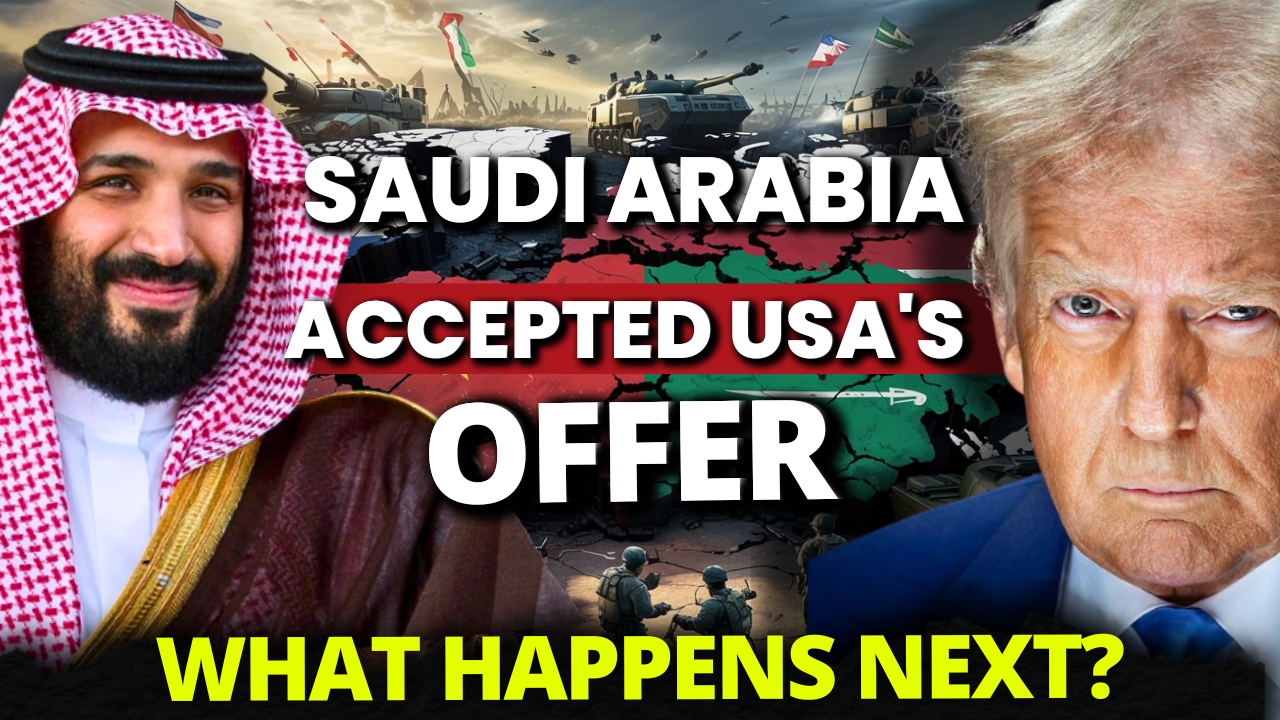
A seismic shift has just occurred in the heart of the Middle East.
After decades of strategic ambiguity,
the United States has made its move…
accepting a high-stakes offer from Saudi Arabia.
The global superpower,
long the dominant force in the region,
now stands on the edge of a geopolitical storm.
Alliances are changing.
Enemies are watching.
And the world is holding its breath.
What does this decision mean for global energy,
military dynamics, and regional power balances?
Could this be the spark that reshapes the entire Middle East?
You need to know what’s coming next. Because the decisions made behind closed doors today… could determine the fate of nations tomorrow.
Before we dive into the core of this unfolding global issue, make sure to LIKE this video, leave a COMMENT with your thoughts, and SUBSCRIBE for more critical insights into the world of international politics and power. Your support ensures we keep delivering the truth with clarity and depth.
The Offer: What Did Saudi Arabia Propose?
In early 2025, quiet murmurs in diplomatic circles grew louder as confidential briefings and leaked cables unveiled a bold, sweeping offer from Riyadh to Washington. It wasn’t just another oil deal—it was a comprehensive realignment strategy, designed to anchor the United States firmly in the Middle East, even as global powers jockey for influence.
At the heart of the proposal was an unprecedented energy security pact. Saudi Arabia offered guaranteed long-term oil supply stability, tied to specific strategic reserve agreements and price mechanisms, designed to insulate the U.S. economy from global energy shocks for decades.
But the crown jewel? Billions—potentially trillions—in direct Saudi sovereign wealth fund investments into critical U.S. strategic sectors: cutting-edge AI research, green energy infrastructure, advanced manufacturing, and next-generation technology hubs across America. This wasn’t passive investment; it was a deliberate move to interweave the Saudi economic future with the American one, promising job creation and technological acceleration in the U.S.
The offer also included a dramatic deepening of security cooperation. Riyadh proposed leading and heavily funding a new regional security architecture, integrating intelligence sharing platforms, joint counter-terrorism operations, and enhanced maritime security patrols in the Red Sea and Gulf. This was framed as a way to directly counter Iranian aggression and reduce the need for expanded, visible U.S. military deployments.
In return, Saudi Arabia sought a fundamental recommitment from the United States: an ironclad, treaty-level security guarantee against external attack, prioritized access to the most advanced U.S. defense technologies (including those previously off-limits), and unwavering U.S. support for the Kingdom’s Vision 2030 modernization agenda, including its civil nuclear program under IAEA oversight.
For the U.S. leadership, the deal glittered with opportunity—but shimmered with risk. Accepting it meant doubling down on a controversial alliance, potentially entangling the U.S. in regional disputes driven by Saudi priorities, and navigating complex domestic political debates. Declining it meant watching strategic rivals like China and Russia potentially fill the vacuum, and forfeiting immense economic and energy security advantages.
Why the U.S. Said Yes
For years, U.S. foreign policy strategists debated the wisdom of a sustained, heavy presence in the Middle East. The “pivot to Asia” became the dominant strategic mantra, suggesting a desire to shift resources and focus towards countering China’s rise. 1 Yet, the Middle East stubbornly refused to fade in importance, remaining a critical node for global energy, counter-terrorism, and the competition between major powers. As China’s economic footprint expanded through initiatives like the Belt and Road, and Russia asserted itself militarily in Syria and diplomatically across the region, Washington faced an increasingly difficult strategic dilemma. Could it genuinely disengage without creating a dangerous vacuum? Maintaining the status quo felt increasingly unsustainable, both financially and politically. It was within this context that Saudi Arabia’s offer landed, presenting a compelling third path.
Saying “yes” to the Saudi offer marked a historic pivot back towards deep engagement, but on potentially different terms. It wasn’t a return to simply being the region’s policeman; it was an acceptance of a partnership where a well-funded regional power was willing to invest heavily, both financially and militarily, in a shared vision of stability and countering mutual threats.
For Washington, the rationale for acceptance was multifaceted and compelling. The energy security pact alone offered immense strategic value. In an era where energy prices remain volatile and can be weaponized – as seen after Russia’s actions in Europe – a guaranteed, stable, and preferential long-term supply from the world’s largest exporter provided a powerful shield for the U.S. economy, potentially mitigating inflationary pressures and reducing vulnerability to geopolitical blackmail.
The economic stimulus promised by the Saudi investment was equally, if not more, attractive. Trillions of dollars directed towards critical U.S. industries and infrastructure aligned perfectly with President Biden’s domestic agenda focused on boosting competitiveness, creating high-paying jobs, and strengthening supply chains. Imagine the political appeal of announcing massive foreign direct investment creating hundreds of thousands of jobs in key states, revitalizing manufacturing, and accelerating American leadership in fields like AI. This wasn’t just economics; it was politically resonant.
Beyond the economic sphere, the strategic advantages were clear. Accepting Saudi Arabia’s proposal to fund and lead a new regional security architecture offered the tantalizing prospect of achieving key U.S. security objectives with less direct American military and financial expenditure. A stronger, more capable Saudi military, explicitly integrated into a U.S.-backed framework and focused on countering Iranian and extremist threats, could become a powerful force multiplier. Enhanced intelligence sharing meant better counter-terrorism capabilities and improved warning systems against missile or drone attacks targeting U.S. assets or allies. It was a way to counter rivals and maintain influence through a partner, potentially freeing up limited U.S. resources for challenges elsewhere.
Most significantly, accepting the offer reaffirmed the United States as the indispensable global security partner, particularly in a region where its influence was being actively contested. By doubling down on this relationship, Washington pushed back against narratives of American decline or withdrawal, signaling its long-term commitment to the Middle East’s stability, albeit in a recalibrated fashion. It demonstrated that while the “pivot” might be real, America retained the flexibility and willingness to make substantial commitments where its core interests were most compellingly addressed.
Ultimately, the decision came down to a calculated risk assessment. While the human rights concerns and potential for entanglement were significant drawbacks, the perceived benefits in terms of energy security, economic growth, and strategic counter-balancing against rivals were deemed too substantial to ignore. The alternatives – continued gradual disengagement or maintaining a costly, unrewarding status quo – seemed less palatable in the face of a rival-infused Middle East and pressing domestic economic needs.
In saying “yes,” Washington gambled on a future where a deepened alliance with Saudi Arabia serves America’s interests, accepting the inherent pressure and controversy that comes with such a powerful, binding partnership.
The Reaction: Allies and Adversaries Respond
The ink on the agreement was barely dry, the diplomatic cables still humming with confirmation, and the tremors had already begun propagating across the globe. The United States accepting Saudi Arabia’s comprehensive offer was not a development confined to Washington and Riyadh; it was a seismic event with immediate, far-reaching reactions from every capital invested in the Middle East and global power dynamics.
Iran, the long-standing regional rival of both the United States and Saudi Arabia, was among the first and most vociferous in its condemnation. Tehran swiftly denounced the deal as a “treacherous pact,” a “strategic encirclement” orchestrated by Washington to isolate and pressure the Islamic Republic. Iranian officials warned darkly of “proportionate and unpredictable consequences,” fueling intense speculation across intelligence agencies about likely retaliatory measures. Expect an immediate uptick in activity by Iran-backed proxy forces across the region – Houthi attacks on Red Sea shipping lanes intensifying, rocket fire targeting U.S. bases in Iraq and Syria increasing, and cyberattacks against critical Saudi and potentially U.S. infrastructure escalating dramatically. Iran’s rhetoric was designed to delegitimize the alliance and rally opposition within the Muslim world.
Moscow, with its entrenched military presence in Syria and expanding political and economic ties across the Middle East, saw the fortified U.S.-Saudi alliance as a direct challenge to its own regional ambitions. Foreign Minister Sergey Lavrov publicly labeled the agreement a “destabilizing provocation,” accusing Washington of attempting to revive Cold War-style bloc politics in a multipolar world. Behind closed doors, Russian diplomats began working furiously, intensifying coordination with Iran, strengthening ties with Turkey and potentially even reaching out to Qatar, exploring every avenue to counterbalance the renewed U.S.-Saudi synergy. The implications for OPEC+, where Russia and Saudi Arabia have co-chaired supply agreements, were immediately thrown into question.
Then came China. For Beijing, which has spent years cultivating economic ties through the Belt and Road Initiative and positioning itself as a neutral diplomatic player in the Middle East, the U.S. acceptance of a deal involving massive Saudi investment flowing into America was a significant setback. While official state media issued carefully worded critiques emphasizing “unilateralism” and the dangers of “external interference,” the true concern was palpable. Riyadh’s economic pivot towards the U.S. threatened China’s investment goals and its narrative of being the region’s reliable, non-aligned economic partner. China’s strategic adjustment would be less about military posturing and more about deepening economic ties with countries wary of the U.S.-Saudi axis, accelerating efforts to settle energy trades in Yuan, and subtly undermining the legitimacy of the new alliance through information operations.
Reactions from U.S. allies were mixed. European nations expressed cautious support, welcoming any move that promised greater regional stability or energy market predictability, particularly given Europe’s vulnerability to energy shocks. However, concerns were immediately raised in capitals like Berlin and Paris regarding the human rights implications of a deeper alliance and the potential for the U.S. to be drawn into regional conflicts that could spill over. NATO allies worried about the implications for burden-sharing and strategic focus.
Israel, while not the central focus of this particular Saudi offer (unlike the previous scenario where normalization was a US demand), reacted with nuanced caution. Publicly, Israeli officials acknowledged the significance of a strong U.S. commitment to regional security. Privately, however, there were likely concerns about Saudi Arabia gaining access to highly advanced U.S. military technology and the implications of a more militarily capable Kingdom for Israel’s own long-term security dominance, particularly if normalization remains off the table or on Saudi terms.
From North Africa to South Asia, embassies scrambled to update cables, reassess their own security relationships with the U.S. and Saudi Arabia, and recalibrate their diplomatic postures in response to this fundamental shift. Countries dependent on either U.S. security guarantees or Saudi economic aid watched nervously, wondering how the new alignment would affect them.
The Risks: What Could Go Wrong
For the United States, accepting Saudi Arabia’s offer is less a comfortable embrace and more a precarious tightrope walk across a chasm of potential pitfalls. While the strategic and economic benefits are significant, the risks associated with this deepened alliance are substantial, potentially profound, and will demand constant, careful navigation.
One of the most immediate risks for the United States is increased regional entanglement. By accepting Saudi Arabia’s offer to lead a new security architecture and committing to an ironclad defense treaty, the U.S. is now more directly bound to the Kingdom’s strategic priorities and its ongoing rivalries, particularly with Iran and its proxies. A Houthi missile or drone strike that escalates, a skirmish in the Gulf, or a conflict driven by Saudi actions against Iranian-backed militias could now trigger treaty obligations or political pressure for direct U.S. military intervention in ways previously avoidable. The “moral hazard” is real: will Riyadh feel emboldened by the U.S. guarantee to take more aggressive regional stances, knowing Washington is now on the hook?
Domestically, the acceptance of the Saudi offer is a political minefield for the U.S. administration. Critics in Congress, particularly from progressive wings and those concerned with human rights, immediately voiced opposition to deepening ties with a regime with a controversial record. Expect contentious congressional hearings, attempts to block specific arms sales or technology transfers, and intense media scrutiny on the nature of the alliance. Civil society groups and human rights organizations will amplify pressure, potentially leading to public protests. The influx of massive Saudi investment into sensitive U.S. tech sectors could also trigger nationalist or economic security concerns, leading to calls for greater oversight or even restrictions.
Furthermore, accepting such a comprehensive package creates a degree of strategic dependence on Saudi Arabia. The promised energy stability and investment flow are powerful benefits, but they also grant Riyadh significant leverage over Washington. What happens if the relationship sours due to disagreements on policy, human rights, or regional strategy? Could Saudi Arabia threaten to cut off investment or disrupt energy supplies to exert pressure on the U.S.? This dependence, while offering benefits, also represents a vulnerability.
The likelihood of increased blowback from rivals is also a significant concern. Iran, Russia, and China, viewing this strengthened alliance as a direct threat, are likely to ramp up efforts to undermine U.S. interests. This could manifest in various forms: sophisticated cyberattacks targeting U.S. government agencies or critical infrastructure, increased support for anti-U.S. or anti-Saudi groups, diplomatic efforts to isolate the U.S. on the global stage, or even direct actions against U.S. assets or personnel in the region. The U.S. homeland itself could become a higher-priority target for state-sponsored cyber threats.
There is also the inherent danger of miscalculation. Despite Saudi Arabia’s willingness to invest and lead, regional dynamics are complex and unpredictable. Riyadh’s strategic initiatives might fail, backfire, or create new unintended consequences. If the U.S. overestimates Saudi Arabia’s capacity to deliver regional stability or underestimates the resilience and adaptability of adversaries, the U.S. could find itself in a worse strategic position, having traded flexibility for a potentially unreliable partnership.
Finally, accepting this offer could strain relationships with other traditional U.S. partners in the Middle East and globally. Countries like Qatar, Kuwait, Jordan, and Egypt, which have their own complex relationships with Saudi Arabia and their own security concerns, may feel sidelined or that their security is now secondary to the U.S.-Saudi axis. European allies may resent the perception that U.S. priorities are being dictated by a single non-NATO partner, particularly if it impacts energy markets or regional stability they rely on.
The stakes for the United States have truly never been higher in this particular relationship.
And the spotlight of global scrutiny has never been brighter on Washington’s choices.
The Future: What Happens Next?
The days ahead are anything but certain, but the acceptance of Saudi Arabia’s offer has set in motion a cascade of expected activity that will profoundly reshape the global economic, military, and diplomatic landscape, with the United States firmly at the center of the maelstrom.
Immediately following the agreement, expect a flurry of implementation efforts. Joint U.S.-Saudi working groups will be established to oversee the flow of Saudi investment into the specified U.S. strategic sectors. We will likely see rapid announcements of major Saudi investments in AI research centers in California, advanced manufacturing plants in the Midwest, or infrastructure projects in the Northeast. These won’t be abstract figures; they will be tangible projects designed to demonstrate the economic benefits of the deal to the American public.
Concurrently, military and intelligence integration will accelerate. Plans for joint military drills, previously scheduled, will likely be expanded in scope and frequency. Discussions will intensify on transferring advanced U.S. defense technologies and establishing the mechanisms for the new regional security architecture, including mapping out command structures and intelligence fusion centers. U.S. surveillance assets and personnel may be strategically repositioned or augmented to better support the integrated security efforts.
Economically, the influx of Saudi capital is expected to provide a significant boost to specific sectors of the U.S. economy. Wall Street is already positioning itself to manage the vast funds, while Silicon Valley companies are likely queuing up for access to Saudi investment in cutting-edge research. This could accelerate technological development in the U.S. but will also require careful management to address concerns about foreign influence in sensitive industries.
In diplomacy, Washington will immediately begin leveraging its fortified relationship with Riyadh. The U.S. will likely work closely with Saudi Arabia to manage global energy markets, using their combined influence to promote stability or counter disruptive actions by rivals. The U.S. may also seek to utilize Saudi Arabia’s enhanced regional leadership role to broker agreements, address conflicts in places like Sudan or Syria, or coordinate policies within regional bodies. Saudi Arabia, with Washington’s explicit backing, is likely to seek greater sway in international forums.
However, this future is inherently fragile. The predicted reactions from rivals will not be mere rhetoric. Iran’s proxies are expected to increase their operational tempo, testing the boundaries of the new security pact. Cyberattacks on both U.S. and Saudi infrastructure are likely to become more sophisticated and frequent. Disinformation campaigns from Russian and Chinese networks will aim to erode domestic U.S. support for the alliance and paint both countries as destabilizing forces. Any misstep – a military incident in the Gulf, a major terrorist attack, a political scandal related to the alliance, or an economic downturn affecting investment – could ignite flashpoints or unravel years of diplomatic effort.
Domestically, the U.S. administration faces the persistent challenge of managing political opposition and public skepticism. Sustaining long-term support for the alliance will require demonstrating tangible benefits while navigating complex ethical and human rights concerns. The political debate surrounding the alliance is expected to be a recurring feature of the American landscape.
Yet, despite the inherent dangers and the bumpy road ahead, one thing is abundantly clear: The United States, by accepting Saudi Arabia’s offer, has committed itself to a significant, long-term role in the Middle East, inextricably linking its own strategic and economic future to that of the Kingdom.
Whether this path leads to unprecedented security, technological advancement, and economic prosperity… or instead to unforeseen entanglement and unpredictable peril… that remains the defining question, one that will be answered in the unfolding years.
The global order is shifting under our feet.
And the United States, by its recent decision, is now deeply, fundamentally anchored in one of its most complex, volatile, and strategically vital corners.
The United States’ decision to accept Saudi Arabia’s far-reaching offer marks a critical, potentially defining turning point in 21st-century geopolitics. It fundamentally reshapes existing alliances, redefines the terms of American engagement in a crucial region, and signals a dramatic new chapter in the ongoing global contest for power and influence.
It is a move born of perceived opportunity. Driven by strategic necessity in a competitive world. And fraught with significant, calculated risk.
But in a region where the past never truly stays buried, where historical grievances simmer, and where old rivalries continue to burn intensely beneath the surface… the consequences of this decision are unpredictable, potentially explosive, and the stakes for the United States, and indeed the world, have never been higher.
The question is not simply what happens next… but who, among the myriad of actors vying for influence, will ultimately shape what happens next.
This is the frontline of a global shift, and the United States is now more deeply immersed in its dynamics than ever before.

Leave a Reply